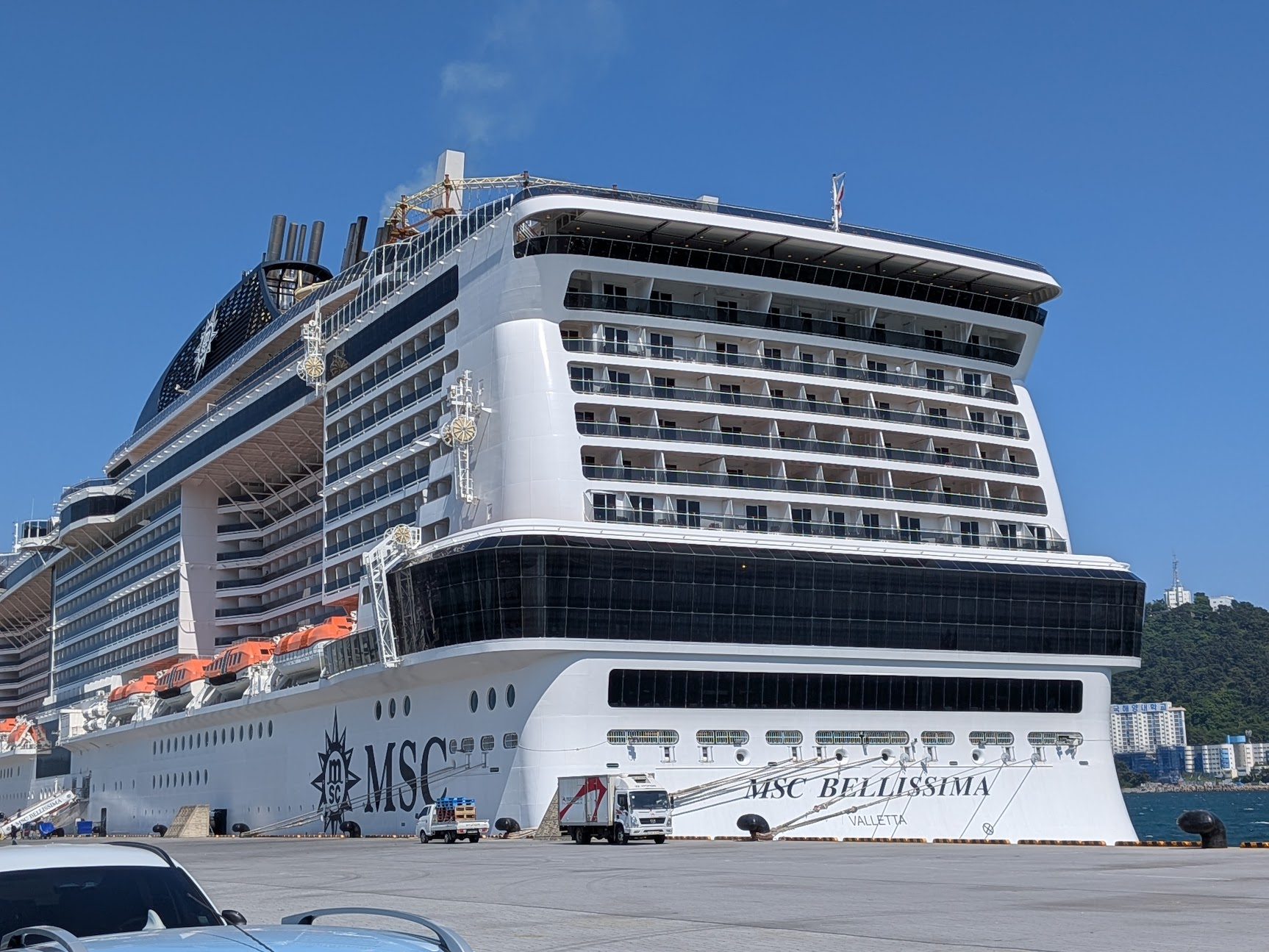
After sailing on MSC Bellissima around Japan and Korea, I kept comparing it with my previous transatlantic cruise on Norwegian Prima. The conclusion was uncomfortable: the NCL trip felt much better.
But the interesting point is not “MSC bad, NCL good.” That is too shallow. The experience was shaped by three layers at once:
- the cruise line’s operating philosophy
- the route and length of the sailing
- the maturity of the cruise market around that route
For my taste, all three layers favored the NCL transatlantic and worked against MSC Bellissima Japan.
The One-Line Take
I do not think MSC Bellissima is a bad ship. I think a very large ship, short Asia route, fixed dining structure, multilingual operation, and high-density leisure model produced exactly the kind of cruise I enjoy least.
Dining: Freedom vs. Assignment
The first difference was dinner.
NCL’s freestyle dining model fits me well. No fixed table, no fixed dinner companion structure, no sense that the evening is assigned before I arrive. I can decide when I want to eat, where I want to sit, and how much social energy I have that day.
MSC Bellissima felt more traditional. Dinner was organized around fixed seating and time slots. That can work for people who like ritual and predictability, but for me it made the ship feel less like a floating retreat and more like a large managed tour.
The buffet amplified that feeling. On a big ship with thousands of passengers, the buffet becomes a stress test of the entire product. When it is crowded, noisy, and hard to sit down comfortably, the ship stops feeling like a resort and starts feeling like a shopping mall food court.
NCL Prima is not immune to crowding. Large ships always fight this problem. But Prima’s Indulge Food Hall and freer dining structure gave me more moments where eating felt chosen rather than processed.
Service: Cheerfulness Matters
The second difference was service style.
On NCL, the service culture felt more actively cheerful. Staff checked in more often, and the default interaction style felt closer to “Are you enjoying this?” than “Here is the next step in the process.”
On MSC Bellissima, service was not absent. It was more transactional. Food arrived. Requests were handled. But the extra layer of warmth was thinner, at least in the standard areas I experienced.
My guess is that the Japan route creates a staffing constraint. Many guests do not speak English comfortably, so multilingual ability may matter more in staffing than it would on an English-dominant transatlantic sailing. That is understandable. But the tradeoff was visible: some staff seemed less used to this service environment, and a few were not fully familiar with the menu content. When language, menu knowledge, and service maturity all became slightly thin at the same time, communication sometimes did not work smoothly.
This is not a blame-the-staff point. It is another route-design point. A multilingual short-haul Asia cruise asks the crew to solve a harder interface problem than a mostly English-speaking long route.
That distinction matters more on a cruise than in a hotel. On land, you can leave the building and reset the mood. On a ship, the service culture becomes the atmosphere. If it feels procedural, the whole ship starts to feel procedural.
Space: A Ship or a Mall?
The third difference was how the public areas felt.
MSC Bellissima is visually impressive. The ship is huge, polished, and full of activity. But I wanted quiet places to sit, read, drink coffee, and feel the sea around me. Those spaces were harder to find than I expected.
This is a subtle but important distinction. A cruise ship can be designed as an entertainment machine, or it can be designed as a place to inhabit slowly. Bellissima leaned more toward the first. The central promenade, retail flow, and crowded buffet areas made the ship feel commercially dense.
Prima also has design compromises, and some venues can feel too small. But on a transatlantic route with many sea days, the rhythm was slower. The ship had time to become a place.
The Market Maturity Problem
There is also a market maturity layer.
European and North American cruising has decades of shared expectations behind it. Passengers know what kind of product they are buying. Cruise lines have had time to refine the rhythm: dining, lounges, shows, sea-day pacing, and the balance between activity and calm.
Asia cruising is still developing as a mass-market product. On a short regional route, the cruise can easily become an extension of group tourism: efficient, dense, multilingual, port-centered, and operationally complex.
The multilingual layer is not cosmetic. It changes the whole service surface. Announcements, menus, dining questions, shore logistics, and complaint handling all have to cross language boundaries. If the operation selects for language coverage, it may not always be selecting for the same kind of polished cruise-service maturity that I felt on the NCL transatlantic.
That explains a lot of the mismatch. MSC Bellissima Japan was not merely a ship; it was a ship inserted into a market still learning what “cruise time” should mean.
Not a Final Verdict on MSC
I would not write off MSC completely.
MSC Yacht Club might solve many of the problems I felt: quiet space, better service, fewer crowds, and a more protected onboard rhythm. A longer Mediterranean itinerary might also feel completely different from a short Asia sailing.
So the lesson is not “never MSC.” The lesson is more precise:
Do not judge a cruise line without separating ship, cabin class, route length, passenger mix, and market context.
For my taste, the specific combination of MSC Bellissima + standard experience + short Japan/Korea route was the wrong stack.
What I Would Book Next
This experience sharpened my cruise-selection filter.
I should prioritize:
- flexible dining
- long sea days
- quieter lounges and cafe-like spaces
- English-speaking social environment
- fewer small-friction add-ons
- mature cruise culture
That points me toward repositioning cruises, transatlantic sailings, Viking Ocean, Holland America, Celebrity, NCL, Virgin Voyages, or eventually Cunard Queen Mary 2. If I try MSC again, it should probably be Yacht Club or a substantially different itinerary.
The bigger lesson is simple: a cruise is not just a ship. It is a whole operating system. And the same hull can feel luxurious, chaotic, social, lonely, restful, or exhausting depending on the route and the layer of the product you buy.
MSC Bellissima gave me a useful negative data point. Sometimes that is exactly what a trip is for.